Microsoft platform depth
Information protection gets easier when you understand the tenant underneath it. Explore our Azure Administrator AZ-104 support, the Azure Security Engineer AZ-500 service, or the Microsoft 365 Administrator MS-102 service.
Microsoft Information Protection Administrator - SC-400
A compliance rollout doesn't pause for exam prep, and a sensitivity-label deadline won't wait either. If you're searching take my SC-400 exam for me, you probably don't need another microsoft information protection tutorial. You need a discreet, practical answer for the Microsoft Information Protection Administrator exam. We coordinate experienced compliance and security professionals, clear communication, and a pass guarantee or refund.
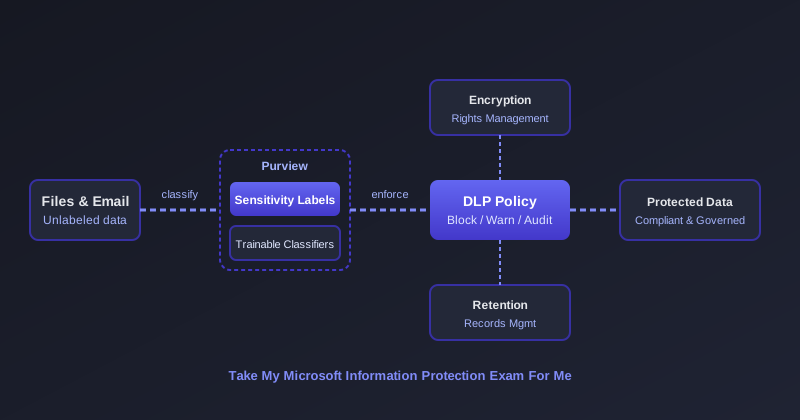
The Microsoft Information Protection Administrator path sounds tidy on paper: classify content, apply sensitivity labels, stop data leaving where it shouldn't, and keep records for as long as policy requires. In the real exam, those tasks collide. A question may describe a tenant with three label taxonomies, a merger in progress, and a legal hold, then ask for the one configuration that satisfies every constraint at once. That is a lot to reason through in 100 minutes.
Even a capable information protection administrator can get caught out. Maybe you've completed microsoft information protection training but rarely touch trainable classifiers. Maybe your organization licenses microsoft information protection e3 features and you've never actually configured the p2 capabilities the exam expects. Or perhaps you've watched every microsoft information protection video available and the scenario wording still feels slippery. It happens. SC-400 expects judgment across sensitivity labels, data loss prevention, information governance, records management, and insider risk.
Then there's the timing. An information protection manager may need the credential to close out a compliance program milestone. Someone chasing microsoft information protection administrator jobs might be interviewing next week. Someone else just wants to stop paying the $165 exam fee after a retake. Those aren't study-motivation problems. They're deadline problems, and they call for a more specific plan.
Here's the SC-400 snapshot in the certification expansion plan. Microsoft can revise objectives, delivery mechanics, and regional pricing, so confirm the booking screen before scheduling.
Exam code
SC-400
Duration
100 minutes
Questions
40-60
Passing score
700 / 1000
Cost
$165 USD
SC-400 questions reward a working mental model, not just a list of Purview portal screens. You may see multiple choice, drag-and-drop ordering, case-study, and scenario items. A microsoft information protection user guide can help, as can SC-400 practice questions, but neither automatically teaches when a policy should be enforced, simulated, or scoped to a pilot group. That distinction is where the exam gets sharp.
01 - Start with the deadline. Tell us when you're booked, your time zone, and whether this is a first attempt or a retake. A search for a microsoft information protection tutor produces a lot of noise; we begin with the facts that decide whether the request is workable.
02 - Receive a clear quote and match. We review the SC-400 format and match the request with a professional who understands Purview labeling, DLP, and governance. You get availability, price, and a simple coordination plan. No vague promises, no endless sales script.
03 - Keep coordination private. We limit communication to what is needed for the scheduled work. Anyone who has typed "is microsoft information protection legit" into a search bar is right to be cautious: exam details and personal data should never be treated casually. We use a need-to-know approach and don't ask for irrelevant information.
04 - Get a prompt outcome. Once the work is completed, we provide an update without drama. The goal is a normal, credible result. If the agreed result is not delivered, the pass guarantee means a free retry or a full refund. Simple.
Information protection is full of reasonable-looking answers. That's exactly the problem. A tenant might have a confidential label, a highly confidential label, an auto-labeling policy running in simulation, and a DLP policy that overlaps with both. Which control actually stops the leak? Does the label apply encryption on its own, or does that require a specific protection setting? SC-400 uses that kind of ambiguity because it mirrors the job.
Sensitivity labels are often where the threads meet. You need to know the difference between a label that simply marks content and one that also encrypts it, restricts permissions, or adds a watermark. Publishing labels to users is one step; auto-labeling based on sensitive information types or trainable classifiers is another. A microsoft information protection tool can show each feature separately in a demo tenant. The exam can ask for the least disruptive configuration that satisfies a messy compliance requirement. Not quite the same thing.
Data loss prevention raises a similar trap. A DLP policy might be technically valid and still be the wrong policy for the scenario. You may need to scope a rule to Exchange Online only, add a user override, escalate to a policy tip, or route a match to an incident report without blocking the message outright. That's why an SC-400 tutor often spends less time on portal navigation and more time asking, "What is this policy actually supposed to prevent, and who gets interrupted if it's wrong?" It sounds obvious. Under a timer, it isn't.
Information governance and records management add another layer of judgment. Retention labels, retention policies, adaptive scopes, and disposition review all interact, and a record-classified item behaves differently from a regular retained one. Strong candidates know the individual features. The difficult questions test sequence and precedence: which policy wins when two retention settings conflict, and what happens to a document that's both labeled as a record and subject to a legal hold.
And there are the licensing and governance edges. Microsoft information protection roles, information protection administrator role assignments, and the gap between microsoft information protection e3 and p2 capabilities all affect whether a configuration is even possible. Someone may be excellent at building labels but struggle with the right role group. Someone else may know every microsoft information protection tutorial by heart yet miss the licensing reason a particular auto-labeling feature isn't available. SC-400 reaches across those boundaries.
There's real value in learning the material. Microsoft information protection ninja training, a microsoft learn information protection module, or a solid microsoft information protection tutorial can give you a good foundation. If you're new to Purview, that work matters. You'll need to recognize how information protection microsoft 365 features fit together before a disposition review or an override request drains a whole afternoon.
But a course and a certification deadline solve different problems. SC-400 combines controls that organizations configure in wildly different ways. Information protection for microsoft 365 varies by tenant. Microsoft information protection for office 365 rollouts vary by department. The exact microsoft information protection administrator role and responsibilities at one company can look nothing like another company's. That means a tidy microsoft information protection user guide can leave gaps even when the explanations are good.
The usual questions tell the story: "What does microsoft information protection protect in this scenario, and what is left exposed?" Or "An analyst asks what is microsoft information protection used for when a user emails a spreadsheet outside the org - which control applies?" Candidates aren't only memorizing settings; they're choosing under pressure. That's why microsoft information protection requirements, DLP drills, and a labeling lab all help, yet may still feel incomplete when your job offer or client deadline is waiting.
If learning is your primary goal, say so. We can discuss a microsoft information protection tutor or conventional SC-400 exam prep instead. If the immediate goal is resolving an exam requirement, we'll be candid about timing and options. Different goal, different route.
If you have room to prepare conventionally, build the plan around work rather than around a giant pile of tabs. Start with the official objectives and map each one to a hands-on task in a trial tenant. Create a sensitivity label and publish it. Build a DLP policy in test mode before switching it to enforce. Walk a document through a retention label and disposition review. Then repeat it with a twist - a different workload, a different override, a different exception. A course feels productive; deliberate retrieval is what makes it stick.
For sensitivity labels, practice moving from a plain label to one with encryption, content marking, and auto-labeling attached. Ask what changes for the end user at each step. For DLP, practice the operational chain from sensitive information type to rule to action to notification, and get comfortable with policy tips and user overrides. Most people can describe these pieces after microsoft information protection training. The useful test is whether you can choose the correct piece when a scenario leaves out a few details.
Use SC-400 practice questions carefully. They're valuable when they make you explain your reasoning, not when they become a scoreboard. A wrong answer can show a gap in terminology, but it may also reveal a wrong assumption about scope or licensing. Keep a short error log. Was the miss caused by a label priority rule, a DLP condition, a retention precedence rule, a role assignment, or plain rushing? Patterns appear faster than you'd think.
Finally, preserve some time for the less glamorous material: microsoft information protection powershell cmdlets for bulk label management, how windows information protection wip and windows information protection policy intune settings interact with device-level protection, and how microsoft information protection vs purview branding maps onto the actual portal you'll use on exam day. Community threads such as microsoft information protection reddit can offer useful perspective, but they can also be outdated within months given how quickly Microsoft renames and reshuffles these features.
Maybe you'll take the classic study route. Maybe time makes that unrealistic. Either way, it helps to understand why the credential matters: SC-400 is not merely a checklist of azure information protection settings carried over from an older product name. It is a way to signal that you can look at sensitive organizational data, apply proportionate controls, and keep the business compliant without freezing normal work. That is a useful capability well beyond the exam screen.
People arrive at SC-400 from very different places. One client may have spent years as an information protection associate handling day-to-day label requests and now needs the full administrator credential for a promotion. Another already runs microsoft information protection solutions for a mid-size company but gets anxious as soon as a timed exam begins. A third has a project deadline, a compliance audit on the calendar, and an SC-400 booking that was made a little too optimistically. There's no single story, and there's no shame in being realistic about your capacity.
The hidden cost is not only the voucher. It's the weekend spent switching between a microsoft information protection certification course, Purview documentation, DLP examples, and microsoft information protection administrator jobs listings that all seem to ask for one more credential. Add a retake, a delayed application, or a postponed internal move, and the whole thing can feel heavier than a 100-minute exam has any right to feel. Sometimes you simply need a clean decision instead of another study resource.
That's why our consultation begins without a lecture. We want the date, the level of urgency, and the outcome you need. If you are trying to learn microsoft information protection from the ground up, a tutoring route may be more valuable. If your immediate concern is a credential requirement, then clear logistics and dependable communication are the priority. We'll tell you which is which, even when the answer is less exciting than a promise of an instant fix.
Compliance work is already about managing uncertainty. You weigh sensitivity against usability, avoid over-blocking legitimate work, and document why a control exists. Treat the certification process similarly. Get the current exam details, choose a path that fits the calendar you actually have, and don't let a pile of contradictory search results make the choice for you. Calm beats frantic. Almost every time.
A short, accurate brief makes the first conversation easier. Have the SC-400 date or target window, your country or testing region, and your preferred timing ready. Mention whether you have already booked through Pearson VUE, whether the requirement is for a role change or a client engagement, and whether you're comparing a microsoft information protection tutor with exam assistance. Details like these let us give a useful answer quickly rather than sending you through a generic intake loop.
It also helps to be honest about the constraint. Is it a tight deadline? A second attempt? A need to strengthen an existing information protection administrator role on your resume? Or are you mainly looking for a clean explanation of microsoft information protection requirements before committing to a study plan? There's a big difference between urgency and uncertainty, although both can feel stressful at midnight. We can work with either when we know which one you're dealing with.
You do not need to send unnecessary records or a long personal history. The practical facts are enough to start: your timing, the certificate, and the result you want. From there, we'll provide a transparent quote and explain the next step in plain language.
SC-400 is a compliance and data-protection credential. It pairs naturally with platform, security operations, and governance certifications, depending on the work you're moving toward.
Information protection gets easier when you understand the tenant underneath it. Explore our Azure Administrator AZ-104 support, the Azure Security Engineer AZ-500 service, or the Microsoft 365 Administrator MS-102 service.
For adjacent detection and response skills, our Microsoft Security Operations Analyst SC-200 help and CompTIA Security+ certification service cover complementary ground.
If you're building toward senior risk, architecture, or leadership work, compare our CISSP exam service, CISM certification support, and CCSP exam help.
The label matters less than the direction. An information protection associate may need the SC-400 credential to prove they can build a compliant labeling taxonomy. A seasoned compliance manager might use it to show Microsoft-specific depth after years of vendor-neutral governance work. Either way, the credential makes most sense when it supports the work you actually want to do.
Send the basics and we'll reply with availability, a transparent quote, and a clear next step. No obligation. Whether you searched "take my SC-400 exam for me" after a long shift or you're planning carefully ahead, a straightforward conversation is a good place to begin.
Share your exam date, region, timing constraints, and whether you're looking for SC-400 exam assistance or microsoft information protection training. We'll take it from there.